
10 November 2026

By Claire Biason, Coalitions and Engagement Programme Manager
(with thanks to Leticia Doormann, our Executive Director, for co-navigating the heat)
Last October, Bangkok was baking, the rainy season was in full swing, and right before Bangkok Climate Action Week (BKK CAW) began, the city suffered major floods. Another reminder of climate change hitting us in the face—just like the heatwave during London Climate Week earlier this year.
Despite it all, Bangkok was buzzing as ever. The TINTA team arrived there with one objective: to better understand the regional ecosystem—needs, opportunities and narratives—to connect with Indigenous Peoples’ and community-based organisations, and to explore potential synergies. We came back inspired and convinced that a regional lens can be strategic for territorial advocacy.
What inspired us the most was finding a more human atmosphere. BKK CAW felt calmer and more coherent. There were events events divided into workstreams, as at other climate events, but the pace allowed for presence. People weren’t frantically rushing between panels; they were actually listening to each other.
And that pace made room for genuine collaboration. Civil society organisations had fertile ground to work in. We met dozens of new people and had honest, unhurried conversations—the kind that reveal real complementarities between organisations rather than rehearsed pitches.
It had a strong regional focus. BKK CAW offered something the bigger global convenings can’t: a clear overview of regional topics, narratives and the players shaping them across Asia. This helped us better understand Asia’s ecosystem, which will be very valuable for our work.
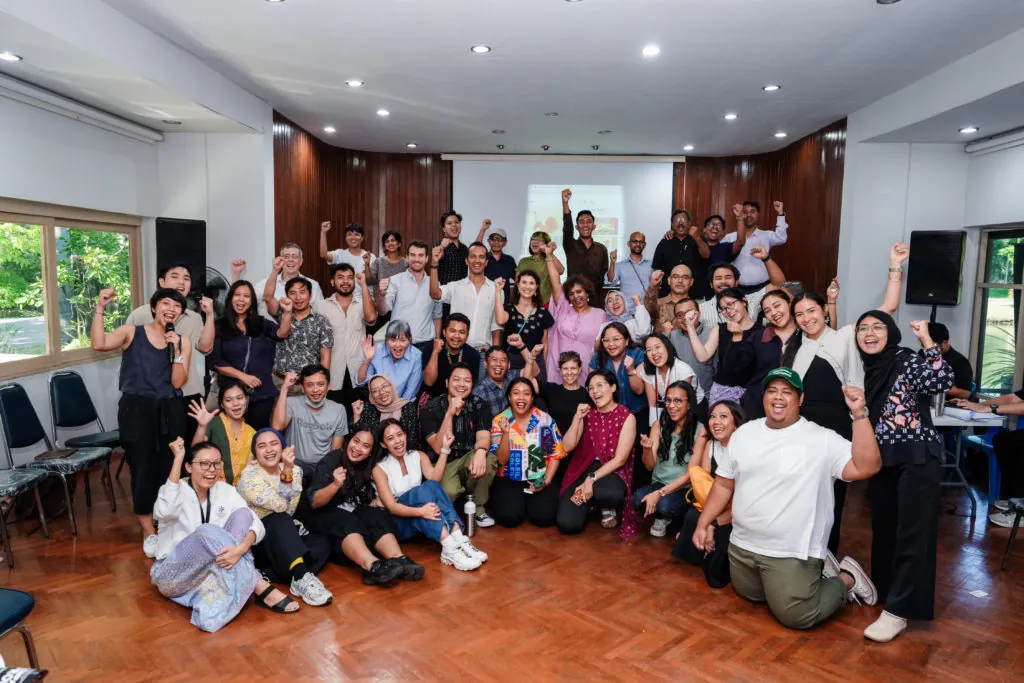
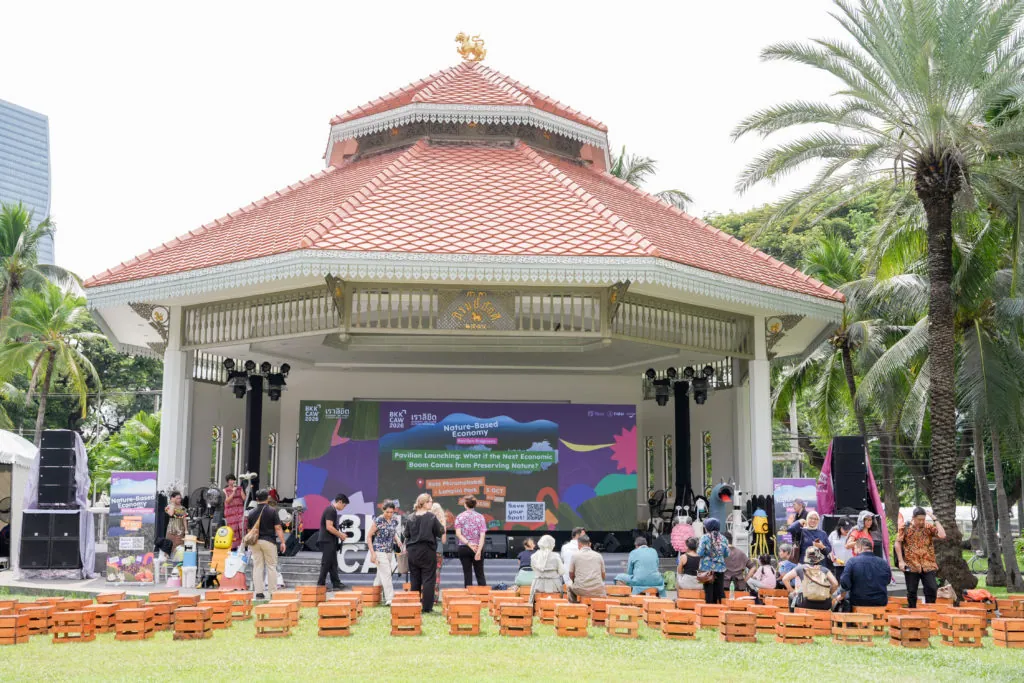
We spent much of our time in the nature-based economy pavilion, led by the Koalisi Ekonomi Membumi (Earth-Centered Economy Coalition, KEM)—and proudly, TINTA was among the collaborators. KEM brings together 29 organisations around strengthening a responsible bioeconomy as an alternative economic pathway to the extractive industries driving so much destruction of nature and community livelihoods. They strengthen midstream companies and connect community producers, buyers, financiers and government to build value chains that create livelihoods while sustaining nature.
What started as an initiative of a few organisations became a collaboration of more than 40 organisations—a telling sign of the collaborative spirit that defined the whole week. What struck us most was the strong Indonesian ecosystem on display: Indigenous Peoples’ organisations, intermediaries, and small companies selling community products, all working in visible, functioning collaboration. Regenerative economies—which in other regions we often call territorial economies—aren’t a theory here. They’re being practised, connected, and scaled. One example was Pinaloka, working with local farmers in Siak, Indonesia, to produce pineapple products while promoting peatland restoration. Other examples were featured in the beautiful Prakarsa film Regenerative economies.
We also greatly appreciated the focus on resilience and exchange that were on full display during the South-South Exchange Learning on Nature-Based Economy for Climate Resilience and the Forest Within Us event, convened by the Peoples for Forests Community. These brought together participants for moments of deep connection, story telling and reflection on what makes us rooted and able to achieve system change. One reflection stayed with us, from a practitioner: “When we work for nature, nature works with us.”
The pressures that communities face—extractive industries and unsustainable supply chains, among others—rarely stop at borders. And neither do the solutions.
We’ve seen this play out in our own work. In 2024, TINTA co-facilitated a learning exchange in Brazil that brought together Small-Scale Fishers leaders from Latin America, Asia, Africa and Europe. One of them, Dani Setiawan of the Kesatuan Nelayan Tradisional Indonesia (Indonesian Traditional Fisherfolks Union – KNTI), later shared:
"Hearing about the challenges and strategies from other continents helped affirm the value of what we're fighting for in Indonesia—it reminded me that our struggles are not isolated, and that small-scale fishers have real power and global relevance."
That exchange did something concrete: it contributed to KNTI breathing new life into what is now called SEAFNET, the Southeast Asia Small-Scale Fishers Network. One gathering, one spark—but a durable structure emerged from it. Seeing that their struggles weren’t isolated encouraged leaders to organise beyond their own country.
That’s the argument for regional strategies. When territorial organisations see their reality reflected in peers across borders, advocacy stops being a series of isolated local fights and becomes a coordinated movement. A single organisation pushing for its rights faces headwinds alone; a regional coalition carries shared evidence, shared narratives and shared political weight.
Here’s the harder question: how do we make moments like that exchange the norm rather than the exception?
In Bangkok, organisations expressed clear interest in connecting across countries—in learning exchanges, in visibility and advocacy support. Not all countries in the region receive the same attention or funding, but the willingness to exchange is everywhere. The task now is to turn that goodwill into rhythm: recurring exchanges, standing communities of practice, joint advocacy agendas—collaboration as infrastructure, not as a one-off event. That is where TINTA’s facilitation role matters most.

We came away from Bangkok with plenty of ideas, lots of new friends, and a shortlist of convictions:
Bangkok Climate Action Week wasn’t just an event for us; it was a confirmation. That a regional angle can be more strategic for collaboration and territorial advocacy than a purely global one. That collaborative beats competitive. That a movement emerges through connections—and that those connections, in turn, strengthen the movement.
We’ll be back next year. And in the meantime, we’re getting to work on the dots that need connecting.