10 July 2026

By Leticia Doormann, TINTA’s Co-Founder and Executive Director
Environmental governance and the protection of forests do not depend solely on decisions made within the territories where these ecosystems exist. They are also shaped in the places where decisions on trade, finance, investment and public policy are made.
That is why creating the conditions for Indigenous Peoples’ organisations and territorial organisations to participate directly in these debates is part of a broader strategy to strengthen their leadership and protect their territories.
Over the past few weeks, as Europe experienced a record-breaking heatwave, TINTA accompanied Indigenous Peoples’ and territorial organisations in London and Paris, two cities where many of the decisions shaping the future of climate, forests, oceans and the communities that protect them are made.
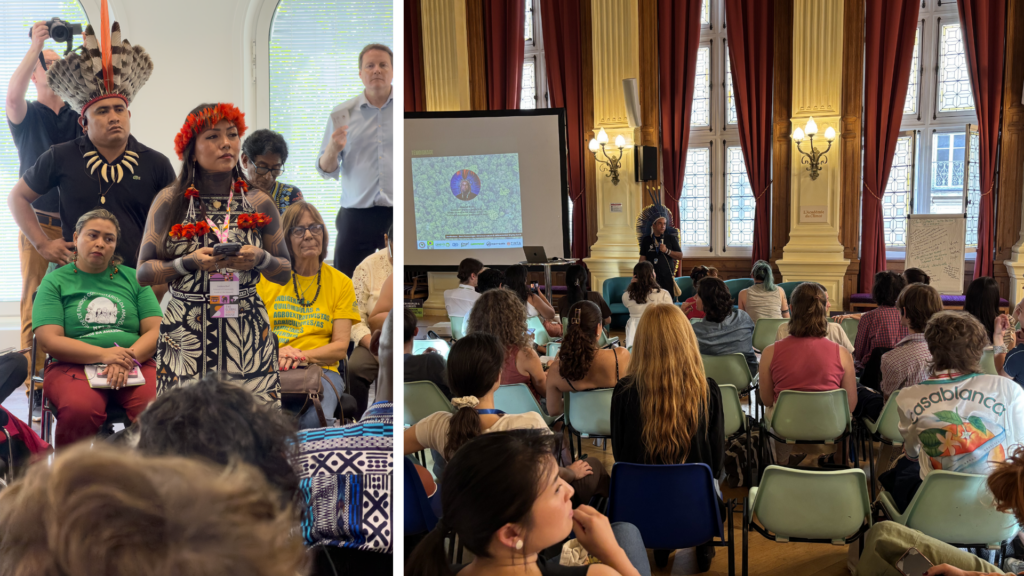
During London Climate Action Week, we worked alongside organisations including Articulação Nacional das Mulheres Guerreiras da Ancestralidade (ANMIGA), Coordinadora de las Organizaciones Indígenas de la Cuenca Amazónica (COICA) the Global Alliance of Territorial Communities (GATC), its Women’s and Youth Movements, and the Shandia Platform to strengthen the presence of Indigenous and territorial leaders in some of the world’s leading discussions on climate and finance.
For ANMIGA, this marked the organisation’s first participation in London Climate Action Week with a delegation bringing together Indigenous women leaders from different Brazilian biomes. As Watatakalu Yawalapiti, one of the co-founders noted, the week has become a strategic convening space where governments, philanthropic organisations and key financial actors come together in one place, an opportunity that is rarely possible through bilateral meetings alone.
To support these efforts, TINTA facilitated a range of events and collaborative spaces, including a conference on Indigenous women’s leadership and direct finance, learning exchanges within the Shandia Learning Community on Territorial Funds, and the preparation of the GATC’s Shandia Forum 2026, including the launch of its report and guide on gender and direct finance.
We also supported political coordination processes, supported interpretation across the GATC agenda, and led communications efforts to increase the visibility and reach of the delegations’ messages, both across advocacy spaces, within their own organisations, and among wider public audiences.
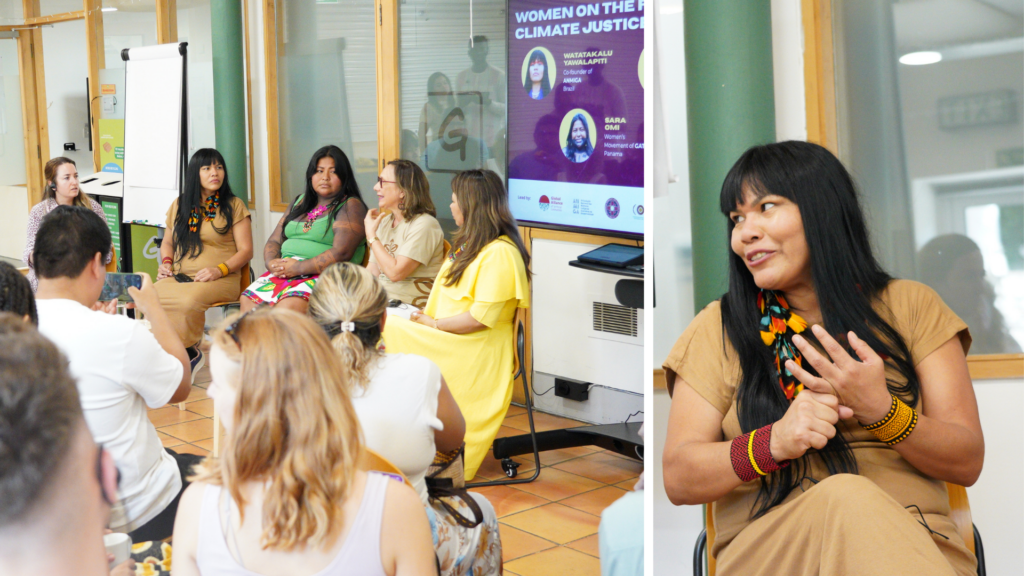
A few days later, we accompanied the Articulação dos Povos Indígenas do Brasil (APIB) during a political mission in Paris, alongside partner organisations including Mighty Earth, Canopée Forêts Vivantes, CRID, Autres Brésils, and Greenpeace France.
During the visit, the delegation held strategic meetings with allies, engaged with journalists, and delivered a letter to Groupe BPCE, France’s second-largest banking group, drawing attention to the role that European financial institutions continue to play in financing supply chains linked to deforestation in Brazil.
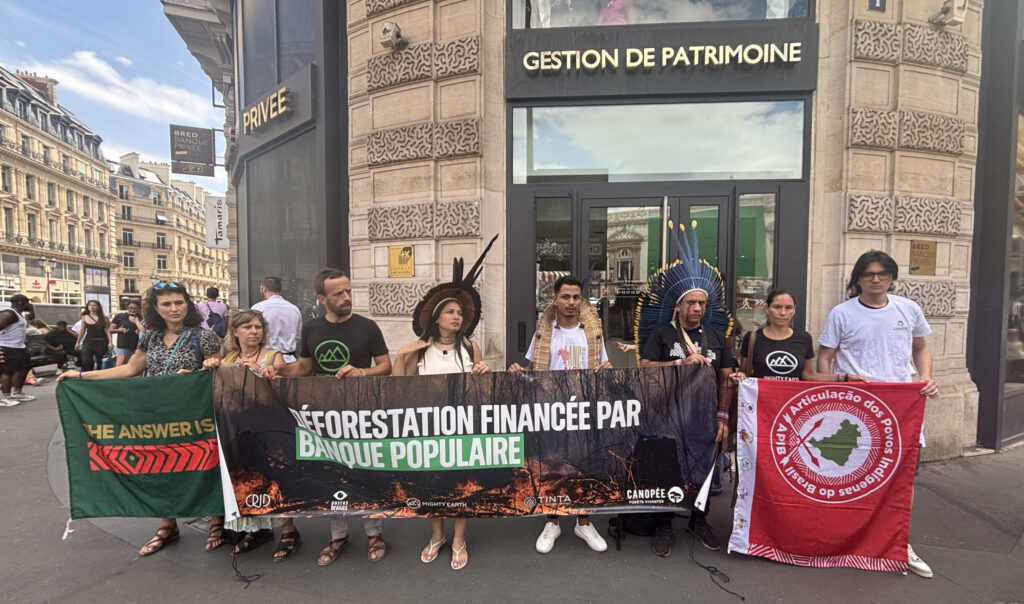
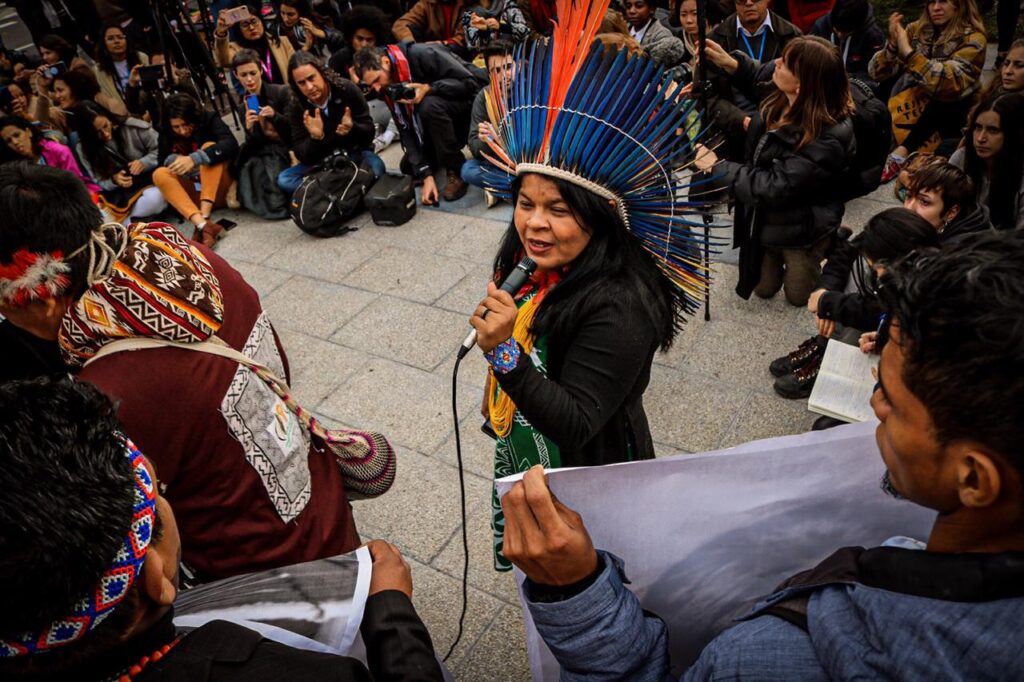
As part of the mission, a public conference was held at the Académie du Climat, bringing together around 150 participants to discuss the relationship between Indigenous Peoples’ rights, forest protection, and Europe’s role in tackling deforestation.
Indigenous leaders from APIB, political representatives, researchers and civil society organisations shared their perspectives on the impacts of global supply chains, the soy and beef trade, the European Union Deforestation Regulation (EUDR), and the responsibility of companies and financial institutions in addressing deforestation.
On this occasion, Luana Kaingang, an APIB Executive Coordinator, shared the following message:
“Being here today, on European soil, is an immense challenge because I have left behind my people, my place, my origins. But I understand that this front line of struggle is also necessary: to engage in dialogue with you, to echo the cry of our communities that have endured so much pain, the voices of our Indigenous relatives, and the children who continue to resist while facing repeated attacks in every corner of Brazilian territory.”
and continued:
“I consider these conversations essential, this space where we can be heard. Coming from a distant reality, I see you as a group willing to strengthen our path, so that what little remains is not exhausted by the capitalist system. We know that profit will not save anyone if the forest does not remain standing.”
The meeting highlighted the direct connection between European policies, consumption patterns and impacts on Indigenous territories, reaffirming a central message: it is not possible to protect forests without guaranteeing the rights of Indigenous Peoples.
For a long time, conversations about territorial governance have focused on what happens within territories themselves. However, many of the pressures these territories face originate elsewhere.
The words of Luana Kaingang and Dinaman Tuxá, also APIB’s Executive Coordinator present in Paris, reinforced a central message: global supply chains, financial investments, trade policies and European environmental regulations, as well as the consumption choices of European citizens, have direct consequences for tropical forests, and ecosystems such as Brazil’s Cerrado, and on the Indigenous Peoples who live in and protect them.
That is why ensuring that the voices of those who live in and care for these territories are present in the spaces where these decisions are made is not simply a matter of representation. It is essential to building fairer and more effective policies.
At TINTA, we believe that territorial organisations do not need intermediaries to speak on their behalf. They need access to the spaces where they can exercise their political leadership directly, build alliances, and participate on equal terms in the conversations that shape the future of their territories.
Our role is to create the conditions for that.
Sometimes this means facilitating exchanges and dialogues. At other times, it involves coordinating agendas, creating advocacy opportunities, strengthening alliances, amplifying narratives and messages, or removing language barriers so that conversations can be genuinely inclusive.
Europe, including Great Britain, continues to play a central role in many of the decisions that affect, and that can also contribute to protecting, the territories of Indigenous Peoples and local communities. From the regulation on deforestation-free products to climate finance policies and international cooperation, decisions made in Europe have impacts that extend far beyond its borders.
However, these instruments can only generate real transformation when the people who live in and protect these territories participate in these processes as political actors, rights holders and holders of knowledge.
That is why our work focuses on building bridges, strengthening alliances and creating the conditions for their leadership to reach the spaces where the future of forests is also decided.
Because protecting the ecosystems that sustain life on the planet requires much more than conserving trees.
Because protecting the ecosystems that sustain life on the planet requires that those who care for them have a voice and influence in the economic, financial and political decisions that affect their territories.