
9 June 2026

Latin America and the Caribbean account for the majority of lethal attacks against environmental defenders worldwide. In 2024 alone, 82% of the 142 killings recorded globally took place in the region. Since the Escazú Agreement entered into force in April 2021 and up to December 2024, 561 lethal attacks have been documented: an average of one killing or enforced disappearance every three days.
So far ratified by 19 countries, the Escazú Agreement is the environmental treaty for Latin America and the Caribbean that guarantees fundamental rights and guidelines for the protection of environmental defenders, as well as access to information, participation in decision-making spaces, and justice in environmental matters.
Against this backdrop, territorial organisations and human rights entities expected that at the Fourth Conference of the Parties to the Escazú Agreement (COP4), held in April in Nassau, Bahamas, States would demonstrate the political will to accelerate the implementation of the only legally binding regional instrument that obliges them to protect those who put their lives on the front line to safeguard the collective right to a healthy environment.
To analyse the outcomes of COP4 and their real implications for those who defend their territories with their own bodies and voices, Global Witness, the Plataforma de Defensoras y Defensores de la Tierra y el Territorio (PDDTyT) of the International Land Coalition (ILC), and TINTA convened a webinar on 28 May.
“Defenders protect the ecosystems and territories on which we all depend. Protecting them is a non-negotiable condition for the future,” said Eva Hershaw of the ILC and co-lead of the Data Working Group of the Alliance for Land, Indigenous and Environmental Defenders (ALLIED).
ALLIED’s 2023 and 2024 reports recorded more than 2,500 non-lethal attacks across 75 countries; 58% occurred in Latin America and the Caribbean. This amounts to nearly 3.5 attacks per day, one-third of which are directed exclusively against Indigenous Peoples.
Threats, criminalisation and evictions are the most common forms of attack, while arbitrary detention and judicial harassment have increased in recent years, signalling an increasingly systematic and organised form of repression. The most affected are Indigenous Peoples, peasant communities and Afro-descendant Peoples.
Gregorio Mirabal, of the Coordinadora de Organizaciones Indígenas de la Cuenca Amazónica (COICA), was unequivocal: “The timelines of States are not the same as the timelines of the territory.” Threats and killings continue even in countries that have already ratified the Agreement. Faced with a reality that cannot wait, COICA attended COP4 as part of the Alianza Latinoamericana de Defensores y Defensoras del Territorio Indígena (ALADTI), maintaining that self-protection remains the only concrete tool in the hands of Indigenous Peoples: “That does not depend on a law or political will. It depends on our spirituality, our ancestors and our historic struggle.”
Javier Garate, of Global Witness, noted that, for the Agreement to have a real impact, it is essential to implement the National Roadmaps — the action plans that each State must develop — and to ensure that they are robust and designed with genuine civil society participation.
Dina Juc, of the Alianza Mesoamericana de Pueblos y Bosques (AMPB), brought the perspective of Guatemala, one of the most dangerous countries for defenders, where the Agreement has yet to be ratified. “Indigenous women do not choose to become defenders. We are born as defenders. And that automatically makes us targets of criminalisation.” For women, gaps in access to information and justice multiply the forms of violence they face. AMPB’s proposals to the Agreement process include Indigenous representation within the regional public mechanism and the creation of a dedicated working group on Indigenous environmental issues.
Samunda Jabini, of the Vereniging van Saamaka Gemeenschappen (VSG), and the only delegate from Suriname at COP4, brought to the discussion a dimension that is often overlooked: the language barrier. The Agreement operates primarily in Spanish and English, excluding countries such as Suriname, where indigenous, maroon, afro-descendant and asian languages coexist. “Ratification is not the only thing that matters: information must reach the people who truly need it, in a language they understand.” She also pointed out that attacks in her country often occur quietly — through rumours, private threats and smear campaigns — meaning that many cases remain undocumented.
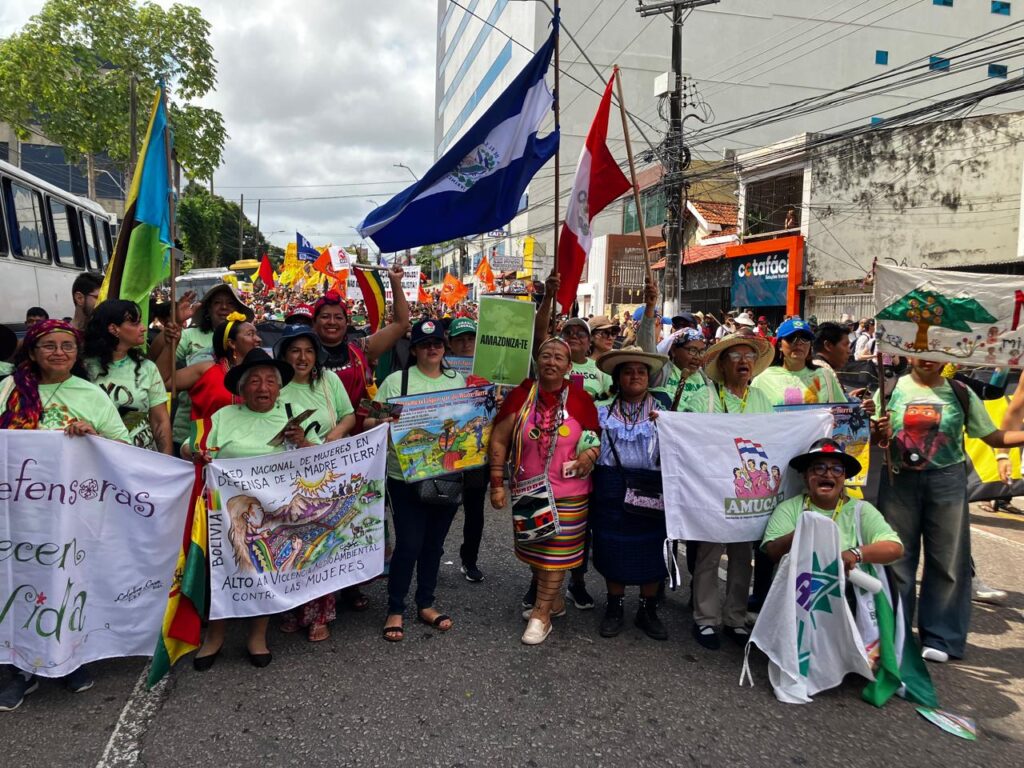
Joara Marchezini, one of the six elected public representatives to the Agreement, highlighted that COP4 approved the continuation of the mandate of the Committee to Support Implementation and Compliance, ensuring that the process can continue to operate autonomously. It also approved the establishment of a Working Group on Access to Justice with formal public representation. She further underscored progress on the Guide for Mainstreaming a Gender Perspective in the Implementation of the Escazú Agreement, adopted at COP3 and further developed at this session. The guide is a key instrument for making visible and addressing the specific situation faced by women defenders.
Participating organisations continue to advocate for the implementation of the Agreement. In the coming months, data will be collected — with a focus on Central America and the Caribbean — for the report on the Action Plan on Human Rights Defenders in Environmental Matters. In addition, public representatives will be renewed this year, a key moment for ensuring that the mechanism reflects the interests of those defending territories.
“The Agreement will not solve every problem, but its implementation is a commitment to life,” Gregorio Mirabal concluded. “Those of us who defend life have no choice but to keep going, and that is why we call on States to ratify and implement it.”