7 May 2026

By Claire Biason, Coalitions & Engagement Program Manager
For millennia, Indigenous Peoples have effectively managed and protected forests. Yet, many communities continue to face extractivist threats ranging from mining and agribusiness to energy and transport infrastructure. The urgent question now is whether the concept of “Just Transition” will repeat these same patterns of dispossession under a green disguise, or whether it will truly honour Indigenous rights, knowledges, self-determination and the defence of life.
That is why the First International Conference on Transitioning Away from Fossil Fuels, held in Santa Marta (also known as the “Heart of the world”), Colombia, this April, marked a pivotal moment. Firstly, 57 countries, representing approximately 1/3 of global GDP, participated in this coalition of the willing to accelerate knowledge-sharing and political momentum on just transition. Beyond official delegates, the conference drew a large crowd of 800 civil society representatives, Indigenous Peoples, Afro-descendant Peoples, farmers, women, youth, and social movements that took over the city and its universities.
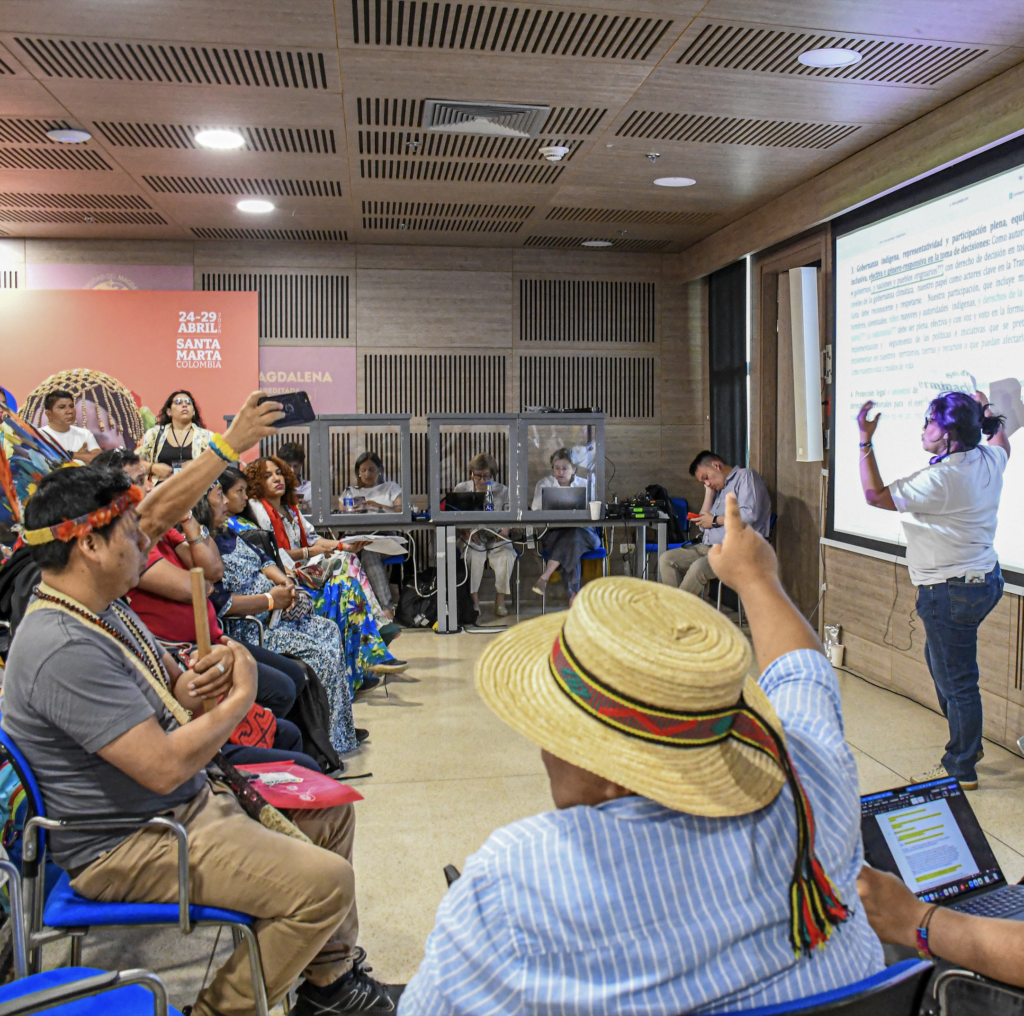
Indigenous Peoples’ leaders came in numbers, especially from Indigenous organisations of the Amazon region such as COICA, COIAB, AIDESEP and CONFENIAE. Over 200 persons registered, amongst which 80 from outside Colombia, and participated in an Autonomous Indigenous Peoples’ Gathering on April 26 and 27 to agree on a joint position that was subsequently shared with the Colombian government and informed the interventions of the two elected Indigenous delegates at the high-level segment of the conference. This gathering was the culminating point of a longer consultation process led by the Organización de Pueblos Indígenas de la Amazonía Colombiana (OPIAC) and the Mesa Permanente de Concertación (MPC), which included three virtual dialogues since March.
This meeting produced a comprehensive position paper outlining thirteen essential principles that must guide any genuine Just Transition, as well as important safeguards. Foremost among these are the rights to self-determination, self-governance and Free, Prior and Informed Consent, asserting that Indigenous Peoples must decide over their territories, lands, and waters, and that their decisions must be respected in all policies and projects affecting them. These principles were translated into actionable proposals across the three pillars of the conference.
Here’s the Indigenous Position in English.
Here’s the Indigenous Position in Spanish.
Janene Yazzie of the Diné people described the gathering as healing, noting that it allowed Indigenous Peoples to autonomously discuss the issues facing their territories and rights without impositions, in an encounter rooted in self-determination.
It was clear from discussions that Indigenous Peoples don’t want fossil fuel extraction on their territories, but they don’t want the extraction of transition minerals either. Therefore, they firmly reject false climate solutions that threaten to perpetuate the very harms the transition aims to solve. Nuclear energy, geoengineering, and other forms of “tech-based colonialism” enable greenwashing and pose grave risks to ecosystems and Indigenous rights. Governments and the private sector must address their climate debt through direct public finance and prioritise absolute and direct emissions reductions, avoiding reliance on market-based schemes and any other current or future offset mechanisms that commodify nature.
For a Just Transition to be real, Indigenous Peoples must have direct control over the financial resources needed to implement their own strategies and regenerative economies. Direct, accessible, adequate and sustained climate funding is critical to ensure that they can exercise their right to self-determination and lead the transition on their own terms without being dependent on external gatekeepers.
To me, one of the most powerful dimensions of this gathering was how the space was used to share learnings and express solidarity across territories. Indigenous Peoples from North America offered poignant testimonies from their homelands, describing how companies extract their resources and destroy their lands and waters while offsetting their damages through market mechanisms that channel benefits to communities in the Amazon for protecting their forests or natural resources. The joint position adopted in Santa Marta stands as a clear rejection of this divisive playbook and a powerful show of unity against a system that thrives on their fragmentation.
The coming months will be decisive. By June, we will know whether the collective position articulated by Indigenous Peoples in Santa Marta finds its place in the final conference report. Regardless of that outcome, this gathering has already established itself as a crucial stepping stone for future climate and biodiversity negotiations. Indigenous Peoples organisations are now building upon this foundational document to craft a concrete Indigenous roadmap of actionable steps for transitioning away from fossil fuels, a process that will be driven by strengthened participation from all seven socio-cultural regions around the globe.
Eyes are also turning toward the newly announced Transitioning Away from Fossil Fuels meetings scheduled for Ireland and Tuvalu in 2027. There is a determined hope that Indigenous representatives will be able to participate meaningfully in these forums. Achieving this, however, requires sustained and targeted support, particularly regarding funding and logistical assistance. Without these resources, the promise of inclusion remains hollow; Indigenous voices must not merely be invited to the table but must be physically present, resourced, and empowered in all stages of decision-making. Only through such genuine, unfettered participation can the world move toward a true Just Transition—one that honours Indigenous sovereignty rather than masking a new form of colonialism in green clothing.
Do you want to know more? Join us on May 12 for the webinar on Navigating the TAFF and deforestation roadmap!